
MODULE 4: CORE MINDFULNESS PRACTICES FOR YOUNG ATHLETES
Objective: To demonstrate main mindfulness techniques tailored to the sports environment and empower young athletes to manage setbacks and emotions effectively.
Sports are full of emotions, the thrill of winning, the sting of losing, nerves before a match, frustration after a mistake. For young people, navigating these emotional ups and downs is just as important as learning technical skills. This module introduces practical mindfulness tools that help athletes stay focused, grounded, and resilient, both on and off the field.
Each technique can be used during regular training, pre-game warm-ups, or recovery. They don’t take much time, but they can make a big difference.
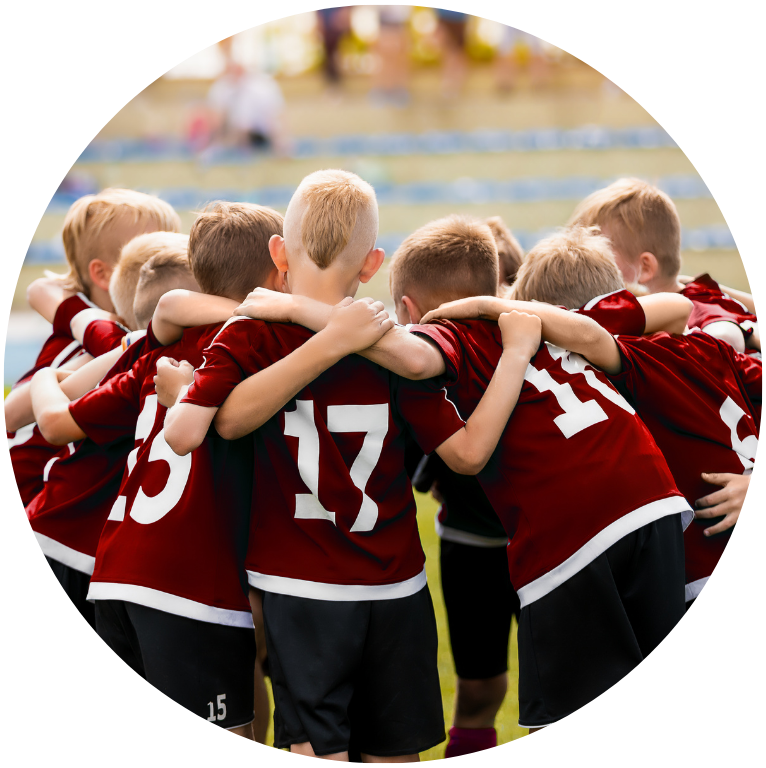

4.1 MANAGING PRESSURE AND PERFORMANCE ANXIETY
Mindfulness helps bring athletes back to the present moment, away from overthinking and back into their body. Pressure is part of every athlete’s journey. Whether it’s the expectations of trainers, the desire to impress parents, or the fear of disappointing teammates, young athletes often carry a weight that goes far beyond physical performance. Even in grassroots clubs, children and by the need to prove themselves. This pressure builds up especially before matches, tryouts, or tournaments and for many, it manifests as anxiety.
The efficacy of mindfulness practices correlates with our increased ability to manage stressors, become more mindfully aware, and experience less anxiety and rumination.
Cognitive anxiety: Broadly defined as “negative expectations, worries, and concerns about oneself, the situation at hand, and potential consequences” and “the perception of one’s physiological arousal.”
Physiologic anxiety: Anxiety is a psychological, physiological, and behavioral state induced in animals and humans by a threat to well-being or survival, either actual or potential. It is characterized by increased arousal, expectancy, autonomic and neuroendocrine activation, and specific behavior patterns.
Performance anxiety is more than just “nerves.” It can show up as racing thoughts, shallow breathing, tense muscles, or even a complete mental block during competition. Athletes may start to catastrophize asking themselves “What if I mess up?” or “I can’t let anyone down”, imagining worst-case scenarios, doubting their abilities, or panicking after minor mistakes. The anxiety often leads to overcompensation, self-sabotage, or simply freezing under pressure. As one trainer in the MindPlay focus groups put it, “You can see it in their eyes they’re not playing the game anymore, they’re stuck in their head.”
- Calm down faster under pressure
- Focus better in high-stress situations
- Recover more quickly after setbacks
- Feel more confident and grounded, even when things go wrong
These moments don’t need to be long or formal. One trainer shared that before big matches, he simply invites the team to stand still together, close their eyes, and breathe in silence for 30 seconds. “I tell them: no need to be perfect, just be present.” These short rituals can become anchors for young athletes, helping them manage pressure not by avoiding it, but by meeting it calmly and confidently.

4.2 MINDFUL BREATHING AND GROUNDING TECHNIQUES
Breathing is the one thing every athlete always has with them-no equipment needed, no extra time required. It’s also the most direct way to regulate the nervous system in stressful moments. When a young athlete feels overwhelmed, frustrated, or frozen by fear, helping them return to their breath can be the fastest way to bring them back into their body and into the present moment.
Mindful breathing is different from simply “taking a deep breath.” It’s about paying attention to the inhale and the exhale, noticing how the body feels as it breathes, and gently guiding the breath to become slower and steadier. A basic practice: inhaling for 4 counts, holding for 2 and exhaling for 6, gives both the mind and body a chance to settle. After just a few cycles, tension starts to release, focus returns, and the athlete is better able to respond to whatever challenge is in front of them.
Grounding techniques go hand-in-hand with breathing. They are especially useful when athletes feel disconnected, anxious, or “zoned out.” These tools work by bringing attention back to the senses and the body anchoring the mind in what is real, concrete, and immediate. One widely used technique is the “5-4-3-2-1” exercise: notice 5 things you can see, 4 you can hear, 3 you can feel, 2 you can smell, and 1 you can taste. It takes less than two minutes and can be done quietly, even during a game or on the bench.
In the MindPlay focus groups, several trainers mentioned that athletes often need a break from mental pressure not a lecture. One shared that before a difficult drill, she simply invites players to “stand still, feel your feet on the floor, and take one slow breath together.” These small moments of grounding are not distractions from sport, they’re tools that enhance performance by clearing away the fog of stress. Once an athlete learns to ground themselves, they’re not just better players, they’re more resilient people.